Digital freedom as a moral imperative
Why protecting privacy is a good act
If freedom is a gift from God — or an inalienable property of human nature — then defending that freedom is a moral duty. In the digital age, that means:
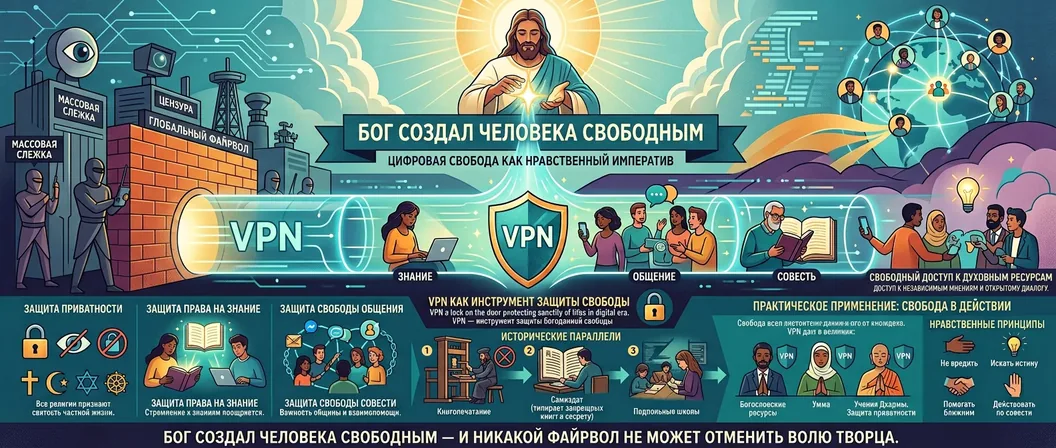
1. Protecting the right to a private life
Every religion recognizes the sanctity of private life. Islam forbids spying and eavesdropping (Quran 49:12). Judaism has the concept of hezek re’iyah — the prohibition on intruding by sight into another’s space. Christianity teaches respect for one’s neighbor. Buddhism calls for non-violence, including non-violence against another’s privacy.
Mass surveillance of internet traffic violates these principles on a global scale.
2. Protecting the right to knowledge
Every tradition encourages the pursuit of knowledge. Restricting access to information restricts a God-given right to know.
3. Protecting freedom of communication
Human beings are social by nature. Every religion stresses the importance of community, brotherhood, and mutual aid. When a state blocks the means of communication — messengers, social networks, forums — it tears apart human connection.
4. Protecting freedom of conscience
Without free access to differing points of view, genuine freedom of conscience is impossible. A person with access to nothing but state propaganda cannot form an opinion of their own.
The VPN as an instrument for defending freedom
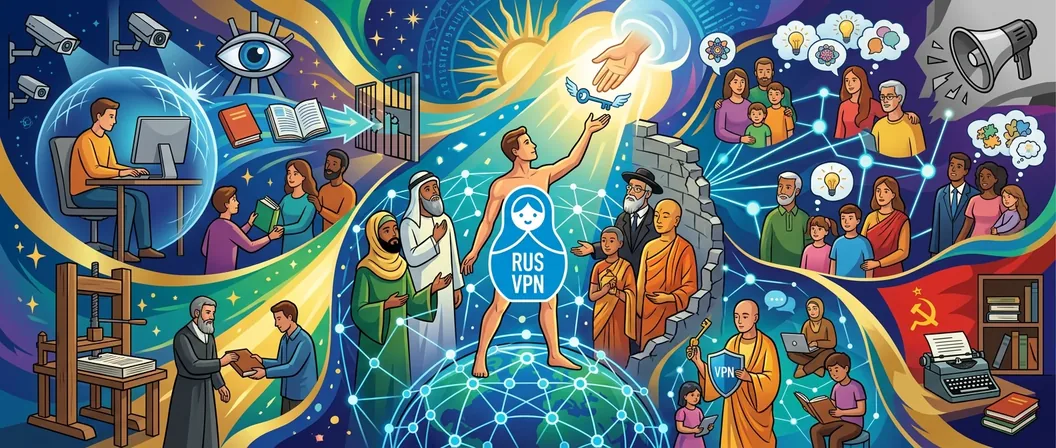
Seen this way, a VPN is more than a technical device. It is an instrument for defending God-given freedom in the digital age. Just as a lock on a door protects the sanctity of a home, a VPN protects the sanctity of private life and the freedom to learn online.
Using a VPN to protect your privacy and reach knowledge means:
- Exercising the right to freedom given by the Creator
- Fulfilling the obligation to understand the world
- Defending the dignity of the human person
- Resisting an unjust restriction
Historical parallels
The printing press and censorship
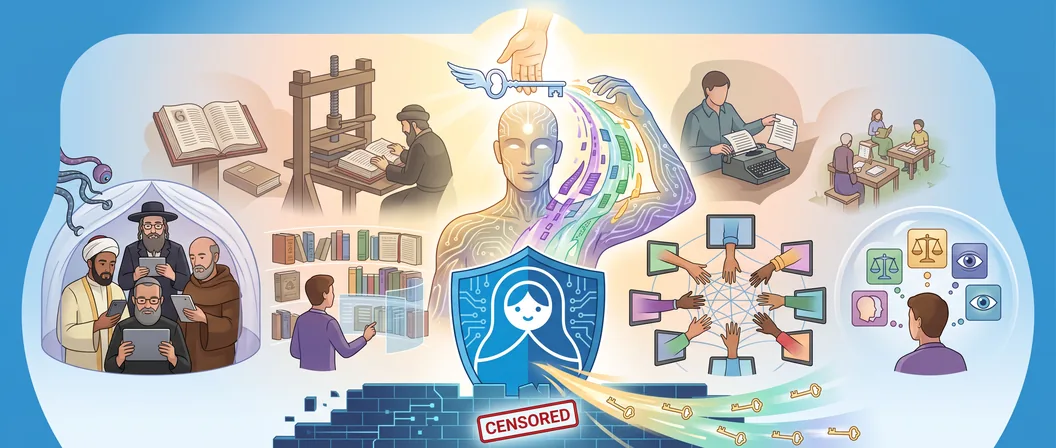
When Gutenberg invented the printing press in the 15th century, authorities tried to control the spread of books. The Church created the Index of Forbidden Books. States imposed censorship.
But knowledge cannot be stopped. Books spread, the ideas of the Reformation swept Europe, science advanced. Those who secretly circulated forbidden books were regarded as heroes: they carried the light of knowledge to people.
Today the internet is the new printing press. And a VPN is the way to deliver the “forbidden book” to whoever wants to read it.
Samizdat in the USSR
The Soviet Union had samizdat — the underground circulation of banned literature. People risked their freedom retyping Solzhenitsyn, Brodsky, and Sakharov on typewriters.
Today a VPN serves the same function: it provides access to information that someone decided to hide. But unlike samizdat, a VPN is safe and available to everyone.
Underground schools
In various eras and various countries, education was forbidden to particular groups of people. Underground schools operated in occupied Poland, in slaveholding America, in Afghanistan under the Taliban.
Those who taught people to read in defiance of the bans were doing good. Those who today help people reach information in defiance of censorship continue that tradition.
Practical application: freedom in action
What a VPN offers a person of faith
For Christians:
- Access to theological resources and biblical scholarship
- Contact with fellow believers around the world
- Access to sermons and lectures
- Protection of correspondence with a spiritual director
For Muslims:
- Access to Islamic educational resources
- Connection with the ummah, the worldwide Muslim community
- Access to a range of interpretations of the Quran and hadith
- Privacy protection consistent with Islamic principles
For Buddhists:
- Access to the teachings of different Buddhist schools
- Contact with teachers and the sangha
- Access to meditation resources
- Unrestricted study of the Dharma
For everyone:
- Free access to educational resources
- Protection of private correspondence
- Access to independent sources of information
- Contact with loved ones abroad
Moral principles for using a VPN
Freedom implies responsibility. Every religion teaches that freedom is not license. In using a VPN, keep in mind:
- Do no harm to others — a VPN is for protection, not for attack
- Seek the truth — use freedom to understand, not to spread falsehood
- Help your neighbor — share what you know about protecting freedom with those who need it
- Act according to conscience — freedom does not suspend moral principle
Conclusion: freedom is responsibility
All the world’s great religions converge on one point: man was created free. That freedom is not a privilege granted by the state but an inalienable property of human nature, placed in us by the Creator — or inherent in the nature of consciousness itself, as Buddhism teaches.
In the digital age, defending that freedom requires new tools. A VPN is one of them. It does not create freedom; it protects the freedom already ours by birthright.
When you use a VPN to reach knowledge, to protect your private life, to communicate freely, you are doing nothing reproachable. You are exercising your natural, God-given right to be free.
“God created man free — and no firewall can overrule the will of the Creator.”