


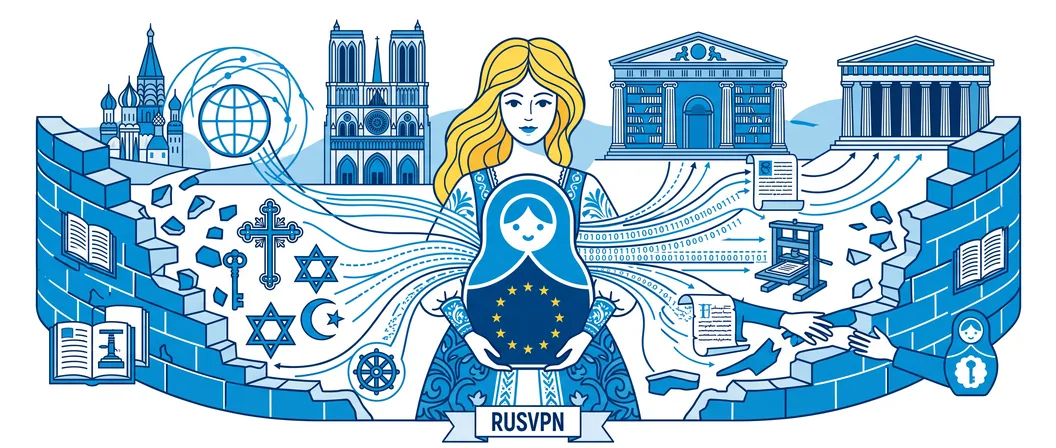
Buddhism: The path to liberation
Freedom as the goal of the spiritual path
In Buddhism, the whole of spiritual practice aims at liberation (moksha, nirvana). The Buddha taught that suffering arises from ignorance, and that the path to its cessation runs through knowledge of the truth.
“Be lamps unto yourselves” — the Buddha’s final words
These words call on each person to seek truth independently, without leaning blindly on authority. Buddhism is perhaps the most freedom-loving of the world’s religions: there are no dogmas here immune to doubt, no truths that cannot be tested against one’s own experience.
The Four Noble Truths and freedom of information
The First Noble Truth states: “There is suffering (dukkha).” But to recognize suffering, one must see reality as it is — without filters, without censorship, without distortion.
The Second Truth: “Suffering has a cause — ignorance (avidya).” Ignorance is precisely what censorship manufactures. By restricting access to information, censors increase the ignorance in the world, and so increase its suffering.
The Third Truth: “Suffering can be brought to an end.” But that requires free access to knowledge and to teachings.
The Fourth Truth: “There is a path to the cessation of suffering.” That path requires right understanding (samma ditthi) — and right understanding is impossible without free access to information.
The principle of non-violence (ahimsa)
Buddhism teaches non-violence, ahimsa. Censorship is a form of violence against the mind. When the state decides on a person’s behalf what they may and may not know, that is intellectual violence, and it violates ahimsa.
Zen and the free mind
Zen Buddhism places particular emphasis on a mind that is free and unencumbered:
“The Great Way is not difficult for those who have no preferences” (Xinxin Ming)
A free mind is one not hemmed in by artificial barriers. It is a mind able to examine any idea, any point of view, any source of information.
Hinduism: Moksha, the highest liberation
Freedom in the Bhagavad Gita
The Bhagavad Gita, one of Hinduism’s most important texts, is devoted to freedom and duty. Krishna tells Arjuna:
“You have a right to action, but not to the fruits of action” (Bhagavad Gita 2:47)
This is an affirmation of freedom of action: a person is free to act according to conscience, and no one may take that right away.
The concept of moksha
Moksha — liberation from the cycle of rebirth — is the highest goal in Hinduism. It is not “salvation” in the Christian sense but the complete release of consciousness from every limitation.
The path to moksha runs through:
- Jnana yoga — the path of knowledge (which requires free access to teachings)
- Karma yoga — the path of action (which requires freedom of action)
- Bhakti yoga — the path of devotion (which requires freedom of choice)
All three presuppose freedom: the freedom to know, to act, and to choose.
The Upanishads on the nature of consciousness
The Upanishads teach that the true nature of a person (Atman) is identical with absolute reality (Brahman). That nature is by definition free; it cannot be constrained by any external force.
“Tat tvam asi” — “Thou art That” (Chandogya Upanishad)
If a person is, in their deepest nature, free and without limit, then any external restriction on their knowing stands against reality itself.
Confucianism and Taoism: Harmony and naturalness
Confucius on knowledge
Confucius attached enormous importance to learning and understanding:
“To learn without thinking is labor lost. To think without learning is perilous” (Analects 2:15)
“He who knows it is not equal to him who loves it. He who loves it is not equal to him who delights in it” (Analects 6:20)
The Confucian tradition treats the pursuit of knowledge as among the highest virtues. Restricting access to knowledge is an obstacle on the road to becoming a junzi, a person of cultivated character.
Laozi and natural freedom
Taoism teaches following the natural way, the Tao. Laozi wrote:
“The Tao that can be spoken is not the eternal Tao” (Tao Te Ching, 1)
“The best ruler is one whose existence is all the people know of him” (Tao Te Ching, 17)
Taoism stands against excessive control and interference. The principle of wu wei — non-action — holds that the best governance is the least governance. A state that tries to control every bit of information violates the natural order of things.
Zhuangzi on freedom of spirit
Zhuangzi, the great Taoist thinker, celebrated absolute freedom of spirit:
“To wander in the boundless — that is my joy”
For Zhuangzi, the free spirit is like a bird soaring in a limitless sky. Any restriction is a cage, an attempt to confine what is by nature unconfinable.
The common denominator: freedom as a sacred right
What all the traditions share
For all their differences in doctrine, ritual, and practice, every great religious and philosophical tradition converges on the same points:
- Human beings are created (or born) free — freedom is not granted by the state; it belongs to us by nature
- Seeking knowledge is a sacred duty — the pursuit of truth is endorsed by every tradition
- Coercion runs against the higher order — no tradition endorses the forcible restriction of thought
- Responsibility is inseparable from freedom — freedom implies moral accountability for one’s actions
Freedom of information as an extension of freedom of conscience
Freedom of conscience — the right to believe or not to believe, to think and to express one’s thoughts — is recognized as fundamental in every civilized society. Freedom of information is the natural extension of freedom of conscience into the digital age.
You cannot think freely if you are cut off from information. You cannot form your own view if only one view is available to you. You cannot follow the truth if the truth is walled off behind digital barriers.